Text commissioned for Linny Venables' exhibition 'Sweet Factory' at the Atkinson, Southport, 2025
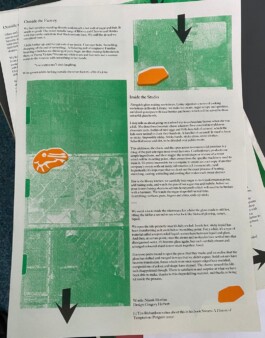
Outside the Factory, Inside the Studio
Glass and sugar are materials which hold onto mystery. Shapeshifters, they can move from crystalline to liquid, they can stretch,
become sticky,
turn smooth and glassy,
turn brittle,
shatter.
We live with the products of this shapeshifting, but mostly, we’re distanced from the material transformations which brought them to us. Most home cooks aren’t regularly heating sugar to shapeshifting temperatures: reaching soft-ball, firm ball, hard ball, soft crack, hard crack on the candy thermometer. Heating and manipulating glass definitely isn’t a process which most of us are able to try at home.
We might think of burning and danger, of fragility and sharp edges, and of skills that we just don’t have. We might think of industrial processes: hot lakes of liquid glass, boiling vats of liquid sugar, industrial secrets. We might even think of magic. Glass was once considered an alchemical material, whilst the ‘magic’ of sweets and of the sweet factory itself still plays a huge role in the marketing of confectionary.
Mostly, when it comes to sweet making, or glass making, we are outside the process.
We are outside the factory.
For Sweet Factory, Linny Venables plays with the satisfaction, and the magic, of material transformations, but she also celebrates the pleasure and therapeutic potential of getting stuck in to making processes, rather than being kept at a distance from them.
Outside the Factory
We’re canal-side, walking past a factory, trying to peer in. The Swizzels Matlow factory in New Mills, Derbyshire is a former textile mill which churns out Love Hearts, Refreshers and Parma Violets. We can’t see much through the windows, which are grubby or clouded with something. We are on a research trip for this exhibition, and we are extremely outside the factory. Swizzels Matlow is not open to visitors.
So, we are trying to imagine inside the factory via the traces that this low-key building emits: the white noise hum of many machines working together, the occasional hot, fruity waft on the air, and this powder, which coats the ground here, and here, and here.
The grass, the gorse, the elderflower and the chain-link fence are covered in a fine white dust.
And one of us realises – could this be sugar? It looks exactly like icing sugar. We run our fingers along the fence. I want to taste it, but I don’t taste it, in case we’re mistaken. Later, when I watch a clip filmed by someone who was allowed inside the factory, I can see the billowing clouds of finely milled sugar which settle on every surface, and I regret not being brave enough to lick my powder coated finger.
Inside the Studio
Glass, like sweets, starts out as a pile of many separate particles.
At its simplest, making glass begins with melting sand. Heat sand (usually mixed with soda ash and limestone) to 1700c and it becomes liquid. Cool, and it doesn’t return to its original form, but transforms into what is called an amorphous solid: a solid in which the molecules and atoms are arranged in a disorganised way, similar to the kind of structure that you’d find in a liquid.
Heat sugar, and it also melts, becomes liquid. Heat it to 146 degrees Celsius and you reach ‘hard crack’ stage, in which almost all water has evaporated from the material. This super hot, super saturated sugar will cool to become hard candy: sweets which have all the light filtering properties of glass, because hard candy shares the disorderly structure of glass. It is this arrangement of molecules, sitting in-between solid and liquid, which makes both materials transparent, and brittle.
In Linny’s studio there’s a glass bowl filled with sweets: pink foam shrimps sitting in a glass bowl scattered with coloured shapes.
or
Liquid sand, transformed, is filled with pieces of liquid sugar, transformed.
Light filters through the bowl and draws the eye. The mouth, or some kind of deep sense memory, knows exactly the sugary hit that the pink shrimps would provide if they sat on the tongue, and the hand just wants to reach out and pop one into the mouth.
But the hand realises first that no, no, these aren’t sweets! They’re cool to the touch, solid and smooth where a foam shrimp would be warm, bouncy and eventually sticky if cupped too long in a hot palm. These shrimps are a trick! Or a tribute? Or a comparison?
Linny explains how she made them: by freezing powdered glass into shrimp-shaped silicone molds, to create a glass-filled ice cube, which could then be fused in the kiln. There is something so domestic about this process, and the closeness of glass making processes to cooking techniques is something that Linny talks about in public workshops she runs during the lead up to the exhibition. In Bootle Library and at the Atkinson, participants make glass bowls, choosing colours and textures to fuse together. We chop and slice small pieces of glass to decorate the bowls. We dust our pieces with sprinklings of coloured frit (powdered glass). We fuse glass magnets in a microwave kiln: an insulating container which reflects microwave radiation to reach temperatures of up to 900 degrees. It feels like glass making has been brought into the kitchen. Glass making – still magic, but a shade less mysterious, and a lot more accessible.
The fused magnets, when they come out and cool, look a lot like boiled sweets.
Outside the Factory
We find ourselves standing directly underneath a hot waft of sugar and fruit. It smells so good. The sweet metallic tang of Ribena and Chewits and Skittles with that earthy undertone that blackcurrants have. We sniff the air and we can almost taste it.
A little further up, and we can sort of see inside. Conveyer belts. Something dropping off the end of something. A flickering roll of wrappers? Familiar branding which has me thinking of party bags: are they making Refreshers in there, or Parma Violets? We can see white coats and hair nets and a woman comes to the window with something in her hands.
“You want some”? she’s laughing.
We’re grown adults lurking outside the sweet factory, a bit of a joke.
Inside the Studio
Alongside glass making workshops, Linny organises a series of cooking workshops at Bootle Library: we make ice cream, sugar syrups and sprinkles, and develop recipes with local berries and honey which will be served in those colourful glass bowls.
Linny tells us about going on a school trip to a chocolate factory when she was a kid. She describes chocolate chaos: a factory floor covered in trodden-in chocolate curls, fistfuls of mini eggs and Biffa bins full of caramel, which the kids were invited to dunk their hands in. A handful of caramel? It must’ve been so sticky. Impossibly sticky. Sticky hands, sticky chins, sticky clothes. Schoolkid sweat and dirt, to be drizzled over public treats.
This stickiness, the chaos, and the open access to commercial premises is a thing of the past amongst most sweet factories. Confectionary products use simple ingredients, and their magic: the novel shape or texture of a sweet which will be its selling point, often comes from the specific machinery used to make it. It’s pretty impossible for a company to create an exact copy of another company’s sweets without inside information.[1]Commercially, (and hygienically) it’s important that we don’t see the exact process of heating, stretching, casting, extruding and cooling that makes each sweet distinct.
But in the library kitchen, we carefully heat sugar to its transformation point, add baking soda, and watch the pan of hot sugar rise and bubble, before we pour it onto baking sheets to set into honeycomb which will need to be broken with a hammer. We watch the sugar shapeshift in real time.
Everything: surfaces, pans, fingers and chins, ends up sticky
* * *
We sneak a look inside the microwave kin whilst the glass inside is still hot, lifting the lid for a second to see what look like blobs of glowing, syrupy, liquid.
When glass is in its molten state it has the consistency of honey or sugar syrup – and, like these, is sticky, when in contact with itself, and sometimes when in contact with other materials. This property of glass allows for endless experimentation: glass can act as a base structure, as well as its own glue.
We open the kiln properly once it’s fully cooled. Inside hot, sticky liquid has been transforming as it cools below its melting point. For a while, it’s a type of material called a supercooled liquid: somewhere between liquid and glass. And then, at a certain point, once the atoms and molecules have settled into that disorganised order, it’s become glass again, but each carefully chosen and arranged coloured shard is now stuck together: fused.
Everyone peers round to spot the piece that they made, and we realise that the glass has shifted and merged in ways that we didn’t expect. Solid colours have become translucent, forms which were once square edged have rounded, compositions of colour and shape have slipped. The chatter around the kiln isn’t disappointed though. There is satisfaction and surprise at what we have been able to make, thanks to this shapeshifting material, and thanks to being let inside the process.
Words: Niamh Riordan
Design: Gregory Herbert
[1] Tim Richardson writes about this in his book Sweets: A History of Temptation (Penguin: 2002)